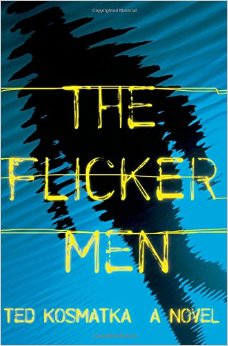
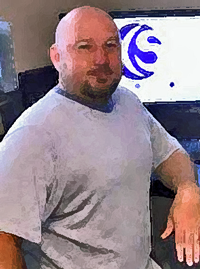
 SFRevu: In The Flicker Men, physicist Eric Argus winds up turning the Feynman double slit experiment into the mother of all Turing tests. The idea of poking at a quantum effect to see where the limits of observation are is pretty compelling. How did you come up with it, and where does the science taper off and the fiction kick in?
Ted Kosmatka: The mother of all Turing tests. I love that. That’s an great way to think of it, actually, though I’d never drawn than connection until you just mentioned it. I can certainly see how the experiment could be interpreted that way. Testing humans, not computers. But what are humans, if not thinking computers? I originally came up with the idea years ago when doing research on quantum mechanics. I was reading on the wave-particle duality of light, and the way in which probability wave functions can be collapsed into existence through force of conscious observation. It seemed so incredibly counterintuitive to me. Why would it matter if something was observed or not? That got me thinking about what the definition of “observer” might be. Shortly after that, I was reading about the famous two-slit experiment and–without giving too much away here–an addendum to that experiment occurred to me. A kind of secondary experiment. At first I assumed that somebody else must have thought of the same other experiment, but when I researched it, I couldn’t find any indication that that particular experiment had been done. This frustrated me, because I really wanted to know what would happen. I wrote the story because I couldn’t perform the experiment in real life.
SFRevu: Science fiction is a reliably white collar medium, but your work stands out because it’s so clearly informed by the blue collar you’ve worn under your lab coat. Do you think about the amphibian nature of your world view and its effect on your writing?
Ted: I’ve often said that I wouldn’t know what to write about if not for all the jobs that I’ve had through the years. Without a job, I’m kind of rudderless, so employment has always given me a direction in life, and has been a path to connecting with people. Work can also help you understand yourself. If you’ve spent 16 hours cleaning out the bottom of a raw material bin in a steel mill, you’ve learned a little something about yourself. I’ve been a zookeeper, and a truck stop dishwasher, and a house painter, and chem tech. I’ve run electron microscopes and shoveled sinter onto conveyer belts. It’s been a fascinating ride, and I wouldn’t trade any of it. I was writing the whole time, but I’ve only been publishing these last ten years or so. Working lots of different jobs is a great way to learn about the world. Writing is a great way to figure out how you feel about it.
SFRevu: If you were to escape from a writer’s workshop or convention (probably by quantum tunneling with a spork) with a few of your closest friends, who would you take with you?
Ted: Well, if I was escaping from a place like that, I’d be escaping with my best writer buddies, and since there’s a whole crew of us up in Seattle who hang out and watch Game of Thrones together, I’d bring all of them along: Jack Skillingstead, Nancy Kress, Ted Chiang, Patrick Swenson, Mark Teppo. It wouldn’t be complete without a few out of town friends like Daryl Gregory, Michael Poore, and Mary-Tina Vrehas.
SFRevu: We already know, thanks to your Locus interview, that you got hooked on sf because you were stuck in a hospital as a child. Where did your reading lead you after that, and what do you read now? (I expect you’re going to say that you read scientific journals, which is fine, but what do you read for fun. Not that science isn’t fun.)
Ted: In all honesty, I read Bova’s Orion and Orson Scott Card’s A Planet Called Treason back to back, and I’m sometimes not sure which one I read first and which one I read second. That whole time period is a bit of a blur. But it’s really those two books that stand out in my mind.
My childhood was filled with a lot of the most popular science fiction novels of the 1980’s, but if I had to name my biggest influence, I’d say it came in the form of twin subscriptions to Asimov’s Magazine and F&SF. I devoured those magazines as fast as they came in, and they are what made me fall in love with short stories. I also read a lot of the Year’s Best collections. Certain stories really stayed with me, and I wasn’t particularly good at keeping track of the title of the stories, or the names of the author, so it’s been a nice treat over the last two decades to stumble across some of those same stories again and realize that they were written by well-known authors in the field. James Tiptree Jr. was one of those great rediscoveries. It was only about 8 years ago that I realized that some of my favorite childhood stories were written by that famous author. In high school, I started reading a lot of Stephen King, and Michal Crichton. I’m also a big fan of Barbara Kingsolver.
SFRevu: For the past five years you’ve worked as a “video game writer” at Valve Games, which sounds like a cross between script-writer and choose-your-own adventure novelist and a lot of fun. How did that happen, and what does a day of work look like? What are some of the projects you’re proudest of?
Ted: I moved on from Valve recently, but working in the video game industry is a both challenging and a lot of fun. The best part of it is that you spend your days working in collaboration with smart, creative people who share a passion for storytelling. You hit the nail on the head in a lot of ways when you called it a cross between script writer and choose-you-own-adventure. There is definitely a little of both of those things thrown in there. As a video game writer, part of your job is to be flexible. I’d have to say the thing I’m proudest of at Valve is my work on Dota 2. It’s a great game with something like 11 million monthly unique players right now, so it’s been a great privilege to be a part of that and watch it grow.
SFRevu: Do you get enough of gaming at work, or do you play for fun?
Ted: I definitely play for fun. There have been many, many times where I’d work all day writing for Dota 2, and then come home at night, and then end up playing Dota 2 before going to bed.
SFRevu: I know you’ve written a play from your experiences working in a steel mill, and I’d d hate to drag your focus from sf, but have you ever considered writing a novel based in you work there? I’d be interested in reading about anyone who went from sintering to scanning electron microscopes.
Ted: I’ve written a fair share of straight up literary fiction, mostly centered around my time at the mills, but those stories always seemed to want to be short fiction, rather than anything novel length. The only ideas I seem to get that feel big enough for a novel are my speculative ideas. My sci-fi thriller ideas. I can see maybe writing a science fiction where the backstory of the main character is connected to the mills, but I suspect my novels will always have some speculative element to them. You never know though.
SFRevu: In Prophet of Bones, you created a young-earth that meshed with Creationist beliefs, but pulled the rug out from under them by facing the where did all this come from question scientifically anyway. In The Flickr Men, you do the same thing to a rational physicist who has to confront demons spawned from quantum physics. Who would you like to unsettle next?
Ted: I actually have a couple of different ideas that are competing in my head right now. I write pretty much every day–either on my short fiction, or my next novel– and I’m really enjoying not having a deadline. I’m looking forward to seeing The Flicker Men on the bookshelves.
SFRevu: So are we. Thanks Ted.
Reference / Links